
Online Marketing for Real Estate Agents: How to Build a Lead System That Actually Closes Deals
 by real on July 23, 2026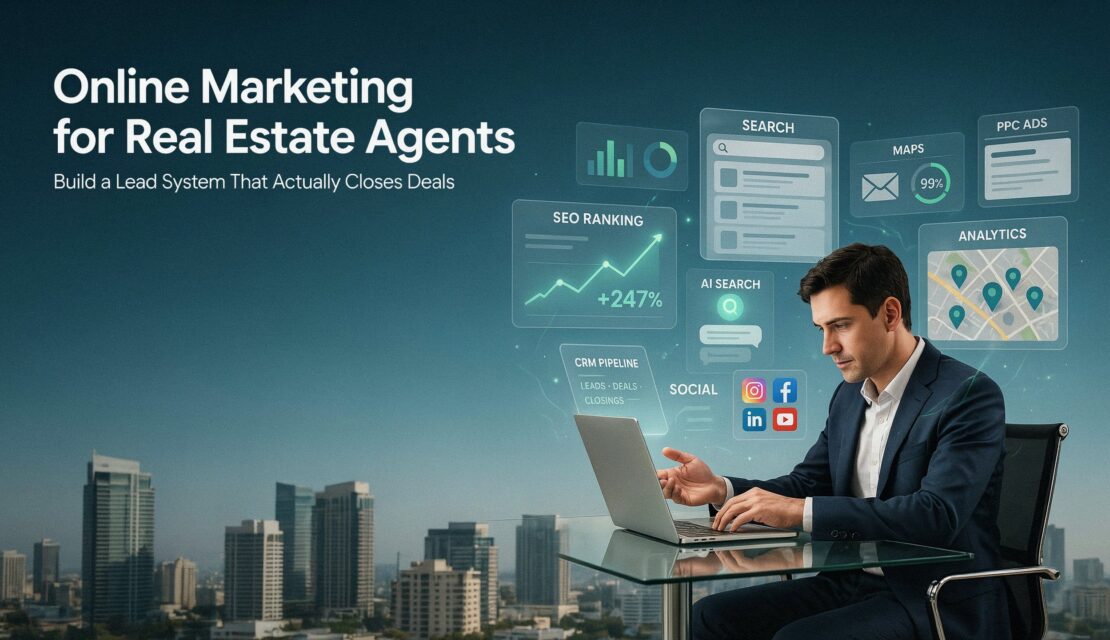
Online marketing for real estate agents is the coordinated use of search, content, listing platforms, social media, email and paid ads to attract buyers and sellers, prove credibility before the first call, and convert that attention into signed clients. The agents who win at it treat it as one connected system with tracked numbers ,not as a list of platforms to post on.
Most agents don’t have a marketing problem. They have a sequencing problem.
They open an Instagram account, boost a listing post, buy a few portal leads, maybe start a blog that stops after four articles ,and none of it is connected. Six months later there’s activity everywhere and pipeline nowhere. Meanwhile the agent two zip codes over, posting less and spending less, is booking listing appointments every week.
The difference is almost never talent or budget. It’s whether the marketing was built as a system.
This guide walks through how that system is actually assembled: how to choose your channels instead of collecting them, how buyers and tenants move from a search query to a signed agreement, what it realistically costs, how to get referenced by AI assistants now that answers arrive before links do, and a 90-day plan you can execute alone.
What Counts as Online Marketing for Real Estate Agents Today?
The definition has quietly widened. Ten years ago, “online” meant a website and a portal profile. Today it includes anywhere a prospect forms an impression of you before you ever speak: a Google Business Profile, a marketplace listing page, a market-update video, a client review, a broker directory entry, even an AI assistant summarizing “best commercial agents in Newark.”
It helps to sort everything you do into three buckets.
Owned, Earned and Paid: The Three Assets Agents Control
Owned assets are the ones you keep: your website, your email list, your listing pages, your video library, your CRM data. They cost time up front and compound afterwards. If you stop paying, they don’t disappear.
Earned visibility is what other people give you: Google rankings, reviews, press mentions, referrals from other brokers, shares, and now citations inside AI-generated answers. You can influence it, but you can’t buy it directly.
Paid reach ,Google Ads, Meta ads, sponsored placements on property marketplaces, paid lead subscriptions ,is rented attention. It’s instant and it’s honest about its price. The moment the card stops, so does the traffic.
Trouble starts when an agent’s entire strategy sits in the third bucket. Paid reach with no owned asset behind it means you’re buying the same lead twice, forever.
Where Marketing Ends and Sales Begins
Worth saying plainly, because it’s the most common misdiagnosis: online marketing’s job is to produce a qualified conversation. It is not to close the deal. If leads arrive and nothing happens, the fix is usually response time and follow-up discipline, not another ad campaign. Speed to first contact does more for conversion than almost any creative decision you’ll make.
Owned assets become significantly more valuable when they’re part of a complete digital marketing strategy for real estate agents, where SEO, local search, content marketing, email campaigns, and conversion tracking work together instead of operating independently.
Why the Old Playbook Stopped Working
Two shifts changed the economics of internet marketing for real estate agents, and both happened faster than most brokerages adapted.
Search Results Now Answer Instead of Referring
Google’s AI Overviews, featured snippets, People Also Ask boxes and local map packs increasingly resolve the query on the results page. A search like “what’s the average price per square foot for warehouse space in New Jersey” often gets answered without a single click. Ranking #1 no longer guarantees a visit.
That doesn’t make search less valuable ,it changes what you’re competing for. You’re now competing to be the source that gets summarized, quoted and named.
Buyers Arrive Already Half-Decided
By the time someone contacts you, they’ve usually read your reviews, scanned your listings, watched a video or two, and compared you against two or three other agents. National Association of REALTORS® research has repeatedly shown a large share of buyers and sellers now find their agent through online search rather than a personal referral ,and consumer housing trend data suggests younger clients specifically favor agents with a visible, credible social presence.
The practical consequence: your marketing has to survive scrutiny, not just generate clicks. A slick ad pointing to a thin profile with two reviews and no recent activity loses to a plain profile with thirty reviews and a market update posted last Tuesday.
How to Choose Your Channel Mix (Instead of Collecting Channels)
Every channel works for somebody. None of them work for everybody. The honest filter is what you have more of ,time or money ,and what you actually sell.
| Channel | What it’s really for | Realistic time to results | Ongoing cost | Skip it when |
| Local SEO + Google Business Profile | “Near me” and city-level demand | 4–12 weeks | Time only | Never ,this is baseline |
| Blog / market content | Compounding trust and long-tail queries | 3–6 months | Time or writer fees | You can’t commit 6+ months |
| Listing platform presence | Ready-to-transact demand | Immediate | Free to moderate | You have no active inventory |
| Video (YouTube, walkthroughs) | Trust at scale, evergreen traffic | 2–4 months | Low, but time-heavy | You won’t be on camera consistently |
| Email nurture | Converting the 90% who aren’t ready yet | Ongoing | Very low | You have no list to nurture |
| Paid search | Capturing high-intent searches now | Days | Continuous spend | You can’t answer leads within an hour |
| Paid social | Building awareness in a farm area | Weeks | Continuous spend | You expect direct-response results |
If You Have Time but Not Budget
Start with local SEO, your Google Business Profile, review generation and one weekly piece of hyper-local content. This is the slowest path and the cheapest, and it produces the leads with the best margins because nobody’s clipping a referral fee off the top. Give it two quarters before judging it.
If You Have Budget but Not Time
Run paid search on high-intent queries, keep a tight retargeting audience, and pay someone to maintain your listing distribution and email nurture. But build one owned asset in parallel ,usually the website plus email list ,or you’ll be renting attention indefinitely.
If You Work Commercial Rather Than Residential
Commercials change the math significantly. The search volume is smaller, the buyer or tenant is a business rather than a household, and the decision involves a committee, a broker, sometimes a lender and an attorney. Consumer-style social campaigns underperform badly here.
What works instead: specialized commercial marketplaces where investors and tenant reps are already searching by SF, cap rate, zoning and submarket; LinkedIn as your primary social channel; genuinely analytical content (absorption trends, submarket rent comps, logistics corridor shifts); and email that reaches a curated list of principals rather than a broad newsletter. A CRE prospect doesn’t want a reel ,they want to know why this 25,000 SF box in Port Monmouth prices differently than one in Paterson.
The Five Stages Every Online Lead Moves Through
Marketing fails most often at the handoffs between stages, not inside them. Map an asset to each one.
1. Trigger. A lease is expiring, a company is expanding, a family outgrew the house. Nobody is searching yet. Your job here is passive presence ,video, social, market reports ,so you’re already familiar when the trigger fires.
2. Research. They search generically: “office space for lease Morristown,” “how much is my property worth,” “best agents in my area.” This is where local SEO, content and marketplace listings do the heavy lifting.
3. Shortlist. Now they’re comparing you against two or three others. Reviews, past transactions, response speed, and how current your online presence looks decide this stage. Nothing you post matters more than a recent, credible review pattern.
4. Contact. A form, a call, a DM, a marketplace inquiry. Friction here is expensive ,every extra required field costs you submissions, and every hour of delay costs you conversations.
5. Conversion. Consultation, proposal, signed agreement. Your CRM and follow-up cadence own this stage entirely.
A frequent failure: heavy investment in stage 2, nothing at all in stage 3. Traffic climbs, inquiries don’t. The fix is usually reviews and proof, not more content.
Getting Cited by AI Assistants and AI Overviews
This is the newest layer of online marketing for realtors, and most agents haven’t touched it yet ,which is exactly why it’s worth doing now.
Language models and AI search features don’t rank pages the way classic search does. They extract, synthesize and attribute. To be included, your content has to be extractable, factually specific, and connected to a recognizable entity.
Write in Passages a Machine Can Lift
Lead each section with a direct, self-contained answer of 40–60 words, then expand. Use question-shaped headings that mirror how people actually ask. Put concrete numbers, ranges and named places in plain sentences instead of burying them in graphics. Add FAQ and Article schema so the structure is machine-readable. A paragraph that answers cleanly on its own is a paragraph an AI can quote ,and citation is the new click.
Build Entity Signals Around Your Name and Your Market
Search systems and LLMs work with entities: people, organizations, places, and the relationships between them. You want your name reliably associated with a specific geography and asset class.
That means consistent name, address and phone across every profile; a real author bio with credentials, license number and transaction history; the same headshot everywhere; linked professional profiles; and content that repeatedly ties you to named submarkets ,Plainfield, Morristown, Port Monmouth ,rather than vague “the tri-state area” language. Consistency is what turns scattered mentions into one recognized entity.
Earn Mentions on Sources These Systems Already Trust
AI answers draw disproportionately from established industry publications, association sites, local news, active discussion forums and well-maintained marketplaces. A specialist commercial real estate platform carrying your listings and your agent profile is a structured, crawlable source that ties your name to real inventory in a real market. That’s a citation surface a personal website alone can’t replicate.
Practical version: get quoted in local business press, contribute data to industry reports, answer questions where practitioners genuinely gather, and keep your marketplace profiles complete and current.
Listing Distribution: The Most Underused Channel in Real Estate
Agents will spend a thousand dollars on ads to reach people who might buy someday, while their actual inventory sits on one platform with a blurry photo and a two-line description.
Distribution is marketing. Every listing page is a landing page that ranks, gets shared, gets indexed, and pulls in demand you never paid for. Treat listings like content assets:
- Photograph properly ,natural light, wide angles, and for commercial, clear floor plates, clear height, dock configuration and access points.
- Write descriptions with the terms buyers actually search: zoning designation, square footage, cap rate, price per SF, submarket name, highway access.
- Include the numbers a serious prospect needs to shortlist without calling you. Withholding basics doesn’t create urgency; it creates bounce.
- Publish across your own site and platforms where your specific buyer already searches.
For commercial inventory, that means being visible where investors, tenant reps and corporate occupiers actually look. Platforms built for commercial property ,including Commerfi, which lists office, industrial, retail and land inventory alongside agent profiles ,put your listings in front of demand that’s already qualified, and give your brand a durable, indexable presence beyond your own domain.
What Online Marketing Actually Costs ,and How to Judge Payback
Vague budgets are why agents quit channels too early. Work backwards from a closing instead.
Track four numbers and nothing else at first:
- Cost per lead (CPL) ,total channel spend ÷ leads generated
- Lead-to-appointment rate ,how many leads become real conversations
- Appointment-to-client rate ,how many conversations become signed clients
- Cost per closing ,total spend ÷ closings from that channel
Run the arithmetic. If paid search costs you $40 per lead, 15% of leads become appointments and 25% of appointments sign, you need roughly 27 leads per closing ,about $1,080 in acquisition cost. Against a residential commission that’s usually fine. Against a small lease commission it may not be. Against a commercial sale it’s negligible.
Rough planning ranges most agents land in: SEO and content, low cash cost but 10–15 hours a month of real work; Google Ads, meaningful monthly spend with high-intent traffic and immediate feedback; paid social, cheaper clicks and softer intent; purchased portal leads, the highest cost per closing but no build time. Lead quality generally runs in reverse order of speed ,the faster the channel produces leads, the more of them are cold.
One rule that saves money: don’t judge any channel on cost per lead alone. A $12 lead that never answers the phone is more expensive than a $90 lead that books.
A 90-Day Rollout You Can Run Without a Marketing Team
Days 1–30: Fix the Foundation
Claim and fully complete your Google Business Profile with service areas, categories, hours and ten current photos. Audit your website on a phone ,if it takes more than three seconds to load or the contact form has more than four fields, fix that before anything else. Request reviews from your last ten clients individually, by name. Standardize your bio, headshot and contact details across every profile you own. Set up basic conversion tracking so you know which channel produced which inquiry.
Days 31–60: Build the Demand Layer
Publish four pieces of local content ,one per week, each answering a specific question with actual numbers from your market. Post one property walkthrough or market update video weekly. Complete and refresh every listing across the platforms your buyers use. Start a simple monthly email to everyone in your database; sending something useful beats sending something polished.
Days 61–90: Add Paid and Measure
Launch one narrow paid campaign ,a single high-intent query set, a tight geography, one clear offer such as a valuation, a submarket report or a private tour booking. Add retargeting for people who viewed listings but didn’t inquire. Then review the four core numbers, cut the worst-performing channel outright, and move that budget into whichever channel produced actual appointments.
Ninety days won’t make you dominant. It will tell you, with evidence, where to spend the next ninety.
The Numbers That Tell You to Scale a Channel or Kill It
| Metric | What it reveals | When to act |
| Organic impressions | Whether search visibility is growing at all | Flat after 4 months → weak topical focus |
| Google Business Profile actions | Real local intent ,calls, direction requests | Declining → stale profile or thin reviews |
| Listing page views per property | Whether distribution is working | Low → wrong platforms or weak photography |
| Form-to-inquiry rate | Friction in your conversion path | Under 2% → shorten forms, sharpen the offer |
| First-response time | The single biggest lever on conversion | Over an hour → automate acknowledgement |
| Cost per appointment | The only ad metric that matters commercially | Rising 3 months straight → audience fatigue |
Review monthly. Change one variable at a time ,running three simultaneous experiments teaches you nothing about which one worked.
Where Agents Quietly Waste Money Online
Renting leads instead of building demand. Purchased leads are fine as a supplement and dangerous as a foundation. They’re sold to competitors simultaneously, they cost more every year, and you own nothing when you stop.
Spreading across every platform at once. Four half-maintained accounts lose to one that’s genuinely active. Pick where your specific buyer actually spends time and go deep.
Marketing listings instead of expertise. Listing-only feeds attract people interested in that property. Insight-led content attracts people interested in you, which is the audience that still exists after the property sells.
Treating the website as a brochure. If it doesn’t capture contact details, it’s a business card with hosting fees.
Chasing volume over fit. Fifty unqualified inquiries burn more hours than five qualified ones and produce less revenue.
Restarting every quarter. Every channel discussed here rewards accumulation. Nine months of consistent effort beats three cycles of enthusiastic three-month launches, every single time.
Should You Do It Yourself or Hire Help?
Do it yourself when you’re early, budget is tight, and you can protect five to eight hours a week. The upside is real: you learn what your market responds to, and that knowledge stays with you regardless of who you hire later.
Hire a specialist when leads are arriving faster than you can follow up, when paid spend exceeds roughly $1,500 a month, or when technical work ,site speed, schema, tracking, campaign structure ,is the bottleneck. Hire for the specific gap. A generalist agency selling “full-service digital marketing” to a solo agent is usually selling retainer, not results.
Never outsource your voice, your client relationships, or your response time. Prospects can tell the difference between an agent who knows the submarket and a scheduled post that mentions it.
The Takeaway
Online marketing for real estate agents isn’t a campaign you launch. It’s an operating system you maintain ,one that has a way to be found, a reason to be trusted, a place to be contacted, and a habit of following up faster than the competition.
The agents producing consistent business online aren’t doing exotic things. They’re doing a small number of ordinary things without stopping: answering questions their market is actually asking, keeping their listings and profiles current wherever their buyers search, collecting proof from every client, and reading their numbers monthly instead of guessing.
Start with the foundation. Add one channel at a time. Measure cost per appointment, not vanity metrics. And give it long enough to compound ,because that’s the only way any of it ever works.
Frequently Asked Questions
Is online marketing for real estate agents worth it for a solo agent? Yes, and arguably more so than for a large brokerage. Local search and content compete on relevance and consistency rather than budget, which is why individual agents routinely outrank franchise offices for neighborhood-level queries.
How long before online marketing produces closings? Paid channels can produce inquiries within days, though early leads are often unqualified. Organic channels ,SEO, content, video ,typically take three to six months to show meaningful traffic and six to nine before they contribute predictable closings.
How much of my commission should go to marketing? Many agents budget somewhere between 5% and 15% of gross commission income, weighted toward owned assets early and paid channels once conversion is proven. The right figure depends on your average commission and how quickly you need pipeline.
Do I still need a website if I’m active on social media and portals? Yes. Social platforms and portals rent you an audience under rules they change without notice. A website is the only asset you control, and it’s where every other channel should ultimately deposit traffic.
Which single channel should I start with? Google Business Profile plus review generation. It’s free, it targets people already searching in your area, and it usually shows movement within weeks.
Does online marketing work differently for commercial property? Substantially. Commercial audiences are smaller, more analytical and more platform-specific. Specialized marketplaces, LinkedIn, data-driven content and targeted email outperform consumer-style social campaigns by a wide margin.
How do I get my business mentioned in AI-generated answers? Publish clear, self-contained answers backed by specific local data, keep your entity details identical across every profile, use structured data, and earn mentions on sources those systems already trust ,industry publications, association sites and established marketplaces.
Can I run this alongside a full transaction pipeline? Realistically, only if you narrow it. Two channels executed consistently will outperform six executed occasionally. Batch content production, automate follow-up, and protect a fixed weekly block for marketing work.
Ready to put your listings where qualified commercial buyers and tenants are already searching? List a property on Commerfi and give your inventory ,and your agent profile ,a visible home on a platform built specifically for commercial real estate professionals.