
Social Media Strategy for Realtors: How to Turn Followers Into Actual Clients
 by wpadmin on July 23, 2026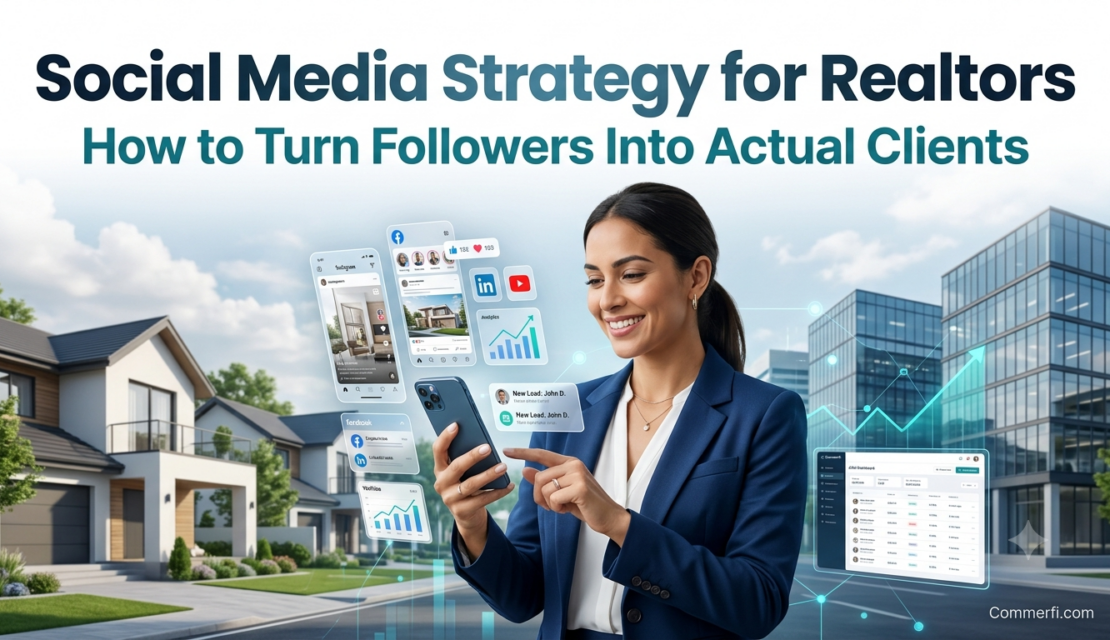
A social media strategy for realtors is more than a posting schedule, it’s a structured plan that aligns your business goals, target audience, content strategy, and lead generation process. Instead of posting whenever inspiration strikes, successful real estate professionals create content with a clear purpose: attracting qualified buyers, sellers, investors, or tenants and guiding them toward becoming clients.
Today, almost every realtor has a presence on social media, but very few have a strategy that consistently generates business. One agent uploads a listing, disappears for weeks, then shares a trending meme hoping for engagement. Another follows a defined content plan, educates their audience, showcases local market expertise, and knows exactly which posts are driving website visits, inquiries, and closed deals. The difference isn’t a bigger budget or a larger team, it’s having a repeatable system designed to build trust and convert attention into revenue.
As social platforms continue to evolve and AI-powered search engines increasingly recommend businesses based on their online authority, consistency, expertise, and credibility matter more than ever. A well-planned social media strategy helps you stay visible across multiple touchpoints while strengthening your reputation with both potential clients and AI-driven search experiences.
If you’re looking to build a complete online presence beyond social media, explore our guides on Digital Marketing for Real Estate Agents, and Online Marketing for Real Estate Agents, where we explain how every marketing channel works together to create a predictable lead generation system.
In this guide, you’ll learn how to define the right audience, choose the most effective social platforms, build content pillars that attract engagement, optimize your presence for AI search, measure what actually drives conversions, and implement a practical 90-day action plan that turns followers into qualified real estate clients.
What a Social Media Strategy for Realtors Actually Means
The word “strategy” gets used loosely, so it’s worth being precise. A real social media marketing strategy answers three questions before a single post goes live:
- Who exactly is this content for?
- What do I want that person to do after seeing it?
- How will I know, with numbers, whether it worked?
Posting without answers to these isn’t a strategy, it’s activity. Activity feels productive because something is going out regularly, but it rarely compounds, because nothing is aimed at a specific outcome. A strategy, by contrast, treats every post as one small step in a longer, deliberate sequence: get seen, get remembered, get trusted, get contacted.
The Three Layers: Presence, Proof and Conversion
It helps to sort your social media effort into three layers, because most realtors are overinvested in one and starving the other two.
Presence is simply showing up consistently, being visible in the feed often enough that your name becomes familiar before anyone needs an agent. This is where most agents put nearly all their energy.
Proof is what makes that visibility mean something: testimonials, market knowledge demonstrated in real time, behind-the-scenes glimpses of how you actually work. Presence without proof produces followers who recognize your face but have no reason to trust you with a six-figure decision.
Conversion is the deliberate mechanism that turns a scrolling stranger into an inquiry, a clear call-to-action, a destination to land on, and a fast follow-up once they respond. Plenty of agents have strong presence and decent proof, then lose the lead anyway because there was never a clear next step.
A strategy simply means giving all three layers deliberate attention instead of only the first one.
Why “Just Posting” Stopped Being Enough
Two shifts changed what it takes to actually generate business from social media, and both happened while most agents were still following advice written for an older version of these platforms.
Algorithms Now Reward Depth Over Frequency
Posting five times a day used to be the whole game. Today, platforms increasingly favor content that keeps people watching, reading or commenting, over content that simply exists. A single well-made property walkthrough with real engagement will now outperform a week of rushed, low-effort posts. Volume without substance quietly gets suppressed rather than rewarded.
Buyers Now Vet You Before They Ever Message You
By the time someone comments on your post or slides into your DMs, they’ve usually already scrolled back through your last ten posts, checked whether you post consistently, and formed an opinion about whether you seem trustworthy or just salesy. That means your feed has to survive scrutiny the moment someone actually looks closely, not just perform well in a single scroll-by. An account that’s all listings and no personality loses to one that clearly shows a real, competent person behind it.
Choosing Your Audience Before You Choose Your Platform
“Homebuyers and sellers” is too broad to build content around. A workable strategy starts with a narrower picture of exactly who you’re trying to reach:
- First-time buyers who are nervous about the process, versus repeat buyers who already know it
- A luxury segment versus a starter-home, budget-conscious segment
- Local families versus out-of-town relocators versus investors
- For commercial agents: tenant reps and business owners searching for space, versus investors evaluating cap rates and hold periods
Once you can picture one specific person, the content nearly writes itself, you know what they’re worried about, what questions they’re too embarrassed to ask, and what would actually earn their trust before they ever reach out.
Choosing Two or Three Platforms, Not All of Them
Trying to maintain five platforms at once usually means doing all five poorly. A stronger strategy picks two or three, based on the audience you just defined, not on whichever platform feels trendiest this quarter.
| Platform | Best for | Content that performs | Time to traction |
| Local, family-oriented buyers and sellers, strong local ad targeting | Posts, groups, live videos, listing ads | Weeks to months | |
| Visual storytelling and property showcases | Reels, Stories, carousel posts | Weeks to months | |
| Investors, relocation clients, commercial and business buyers | Market analysis, deal stories, professional updates | 1–3 months | |
| YouTube | Long-term, evergreen search traffic | Full property tours, buyer/seller education | 2–4 months |
| TikTok | Younger, first-time buyers, organic reach | Short, authentic video, myth-busting | Weeks |
For residential agents targeting families, Facebook and Instagram usually carry the load. For commercial and investor-facing agents, LinkedIn tends to outperform every other platform combined, the audience there is smaller, but far more qualified.
The Five Stages a Follower Moves Through Before Becoming a Client
Strategy usually fails at the handoffs between stages, not inside any one of them. Map your content to each stage deliberately.
1. Discovery. Someone sees your content for the first time, through the algorithm, a hashtag, a share, or a search. Your job here is simply to be worth a second look, a strong hook, a genuinely useful piece of information, a well-shot property.
2. Familiarity. They see you again, and again. This is pure repetition, and it’s why consistency matters more than any single “viral” post. Familiarity is what makes your name feel recognizable rather than random six months from now.
3. Trust. They start believing you know what you’re talking about. Market updates, real numbers, client stories, and behind-the-scenes competence build this faster than polished but generic motivational content ever will.
4. Contact. A comment, a DM, a click to your website, a form fill. This is where friction quietly kills momentum, if there’s no obvious next step, interested people simply keep scrolling instead of reaching out.
5. Conversion. A booked call, a signed buyer agreement, a listing appointment. This stage belongs to your follow-up speed and your CRM, not to social media itself.
A common failure pattern: heavy investment in discovery and familiarity, almost nothing at stage three or four. Followers climb, DMs stay quiet. The fix is usually adding real proof and a clearer call-to-action, not posting more often.
Building Content Pillars So You’re Never Guessing What to Post
Content pillars are a small, repeating set of topics you rotate through, so you’re never starting from a blank page on a Tuesday morning. A workable pillar set for most realtors looks like this:
- Market education, pricing trends, rate updates, what’s actually happening locally right now
- Property spotlights, listings, walkthroughs, “just sold” stories
- Local expertise, neighborhood guides, community events, school or submarket information
- Personal brand, your process, your story, real client testimonials
- Direct engagement, polls, Q&As, myth-busting, comment-bait questions
Rotating through four or five pillars keeps content genuinely varied without requiring a fresh idea from scratch every single day, you’re cycling through categories you’ve already thought through once.
Getting Found by AI Assistants, Not Just the Algorithm
This is the layer almost no realtor has touched yet, and it’s exactly why it’s worth doing now. AI assistants and AI-powered search increasingly summarize “top real estate agents in my area” or “best realtor for first-time buyers” directly, sometimes pulling from social profiles, reviews and public posts rather than sending someone to a feed to scroll.
Keep your identity consistent everywhere. Same name, same headshot, same bio language, same service area across every platform, your website, your listing profiles, and every social account. Inconsistency quietly breaks the pattern-matching these systems rely on to recognize you as one clear, connected entity.
Write captions that stand on their own. A caption that clearly answers a real question, “here’s what closing costs actually look like in this market”, is far more extractable and quotable than a vague one relying entirely on the image for meaning.
Let your expertise show up in specifics. Named neighborhoods, real numbers, actual transaction details. Vague, generic captions blend into every other agent’s account; specific, local detail is what makes content worth surfacing and citing.
Setting a Cadence You Can Actually Sustain
An ambitious posting schedule that collapses after two weeks does less for you than a modest one you keep up for a year. Most realtors see steady, compounding results posting three to five times per week across their chosen platforms, spread out rather than dumped all at once.
A simple, sustainable weekly rhythm:
- Monday: market update or local news
- Wednesday: property spotlight or walkthrough video
- Friday: local expertise or neighborhood content
- Weekend: personal brand or direct engagement post
Batch-creating a week or two of content in one focused sitting, rather than scrambling for an idea every morning, is what actually makes this cadence sustainable past the first month.
What a Social Media Strategy Actually Costs, and How to Judge It
Vague effort with no numbers attached is why most agents abandon social media right before it would have started working. Track a small number of real metrics instead of chasing follower count.
- Engagement rate, comments and shares relative to followers, a far better signal than raw likes
- Click-through rate, how many viewers actually visit your website or landing page
- Lead source, which platform and which content type is producing inquiries you can trace back
- Cost per lead, for any paid boosting or ad spend layered on top of organic content
If organic content alone is producing a handful of qualified conversations a month, that’s often worth more than a much larger following that never converts. If you add paid social, judge it the same way you’d judge any other ad channel, by cost per appointment, not cost per click.
A 90-Day Rollout for Realtors Starting From Scratch
Days 1–30: Set the Foundation
Pick one specific, measurable goal, for example, fifteen qualified inquiries per month from Instagram. Define your target audience in one sentence. Choose two platforms based on that audience. Build five content pillars and write out your first two weeks of posts in one sitting. Clean up your profile, bio, contact link, professional photo, so it converts, not just looks nice.
Days 31–60: Build Consistency and Proof
Post on your chosen cadence without skipping weeks. Start collecting and sharing real client testimonials as they come in. Introduce one interactive format weekly, a poll, a Q&A, a comment-bait question, to start building genuine two-way engagement instead of one-way broadcasting. Reply to every comment and message within a few hours.
Days 61–90: Add Paid Reach and Measure
Boost your two or three best-performing organic posts to extend their reach into a specific target area. Review your engagement, click-through and lead-source numbers monthly, not daily. Drop whichever content pillar is consistently underperforming, and double down on whichever one is actually producing conversations.
Ninety days won’t make you the biggest account in your market. It will tell you, with real numbers, exactly what to keep doing and what to stop.
The Numbers That Tell You to Double Down or Change Course
| Metric | What it reveals | When to act |
| Engagement rate | Whether content is genuinely resonating, not just being seen | Flat for 6+ weeks → refresh pillars or format |
| Profile visits after posts | Whether content is driving people to check you out further | Low → weak hook or unclear caption |
| DM / comment inquiries | Real interest converting into contact | None after a month → add a clearer CTA |
| Click-through to website | Whether social is feeding your owned assets | Under 1% → the CTA or destination needs work |
| Response time to inquiries | The single biggest lever on whether interest converts | Over a few hours → set up faster alerts |
Review monthly. Change one variable at a time, cadence, pillar mix, or platform, so you can actually tell what caused the shift.
Mistakes That Quietly Derail a Realtor’s Social Strategy
No defined goal. Posting without knowing what success looks like makes it impossible to know whether you’re improving or just staying busy.
Trying to be everywhere at once. Five half-maintained accounts consistently lose to two that are genuinely active and well cared for.
Only posting listings. An account that’s all sales pitch trains followers to scroll straight past it.
Copying content ideas without localizing them. A trend or format that worked in another market often falls flat without your specific local numbers and context behind it.
Never reviewing the data. Without checking what’s actually working, the strategy never improves, it just repeats itself indefinitely.
Giving up too early. Most accounts need a few consistent months before results become visible; quitting in week three is the single most common reason social media “doesn’t work” for an agent.
Should You Manage This Yourself or Hire Help?
Do it yourself when you’re early, budget is limited, and you can protect a few focused hours a week for content and engagement. You’ll learn exactly what resonates with your specific audience, and that knowledge stays useful no matter who you hire later.
Hire help when inquiries are arriving faster than you can respond to them, when video editing or design is consistently the bottleneck holding back your posting schedule, or when you’re ready to layer in paid social and need someone managing targeting and budget properly.
Never outsource your actual voice or your response time. A ghostwritten caption that sounds like everyone else’s loses to an imperfect one that clearly sounds like you.
Conclusion
Social media should never operate in isolation. The highest-performing real estate businesses combine organic content, search visibility, paid advertising, and marketplace exposure into one integrated strategy. For a deeper look at social media, digital marketing, and online marketing strategies, explore the resources available on Commerfi and start building a marketing system that consistently attracts qualified buyers, sellers, and investors.
Frequently Asked Questions
How is a social media strategy different from just posting regularly? A strategy defines a specific goal, target audience, content plan and a way to measure results before anything goes live; posting without one is just activity with no clear direction or way to know if it’s actually working.
How many platforms should a realtor actually manage? Two or three, chosen based on where your specific audience spends time, consistently outperform five or six managed halfheartedly.
How often should realtors post to see real results? Three to five times per week, spread out consistently, tends to produce steadier, more sustainable growth than infrequent bursts followed by long gaps of silence.
What kind of content generates the most leads for realtors? Educational and local-expertise content, market updates, neighborhood guides, real buyer and seller tips, tends to generate more qualified engagement than listing photos alone.
How long does a social media strategy take to start producing leads? Most agents see real traction after a few consistent months; it builds slowly at first and then compounds, so the biggest results usually show up later than agents expect.
Do realtors need a paid ad budget for social media to actually work? Not necessarily. A consistent, well-planned organic strategy can build a genuine audience over time, though a modest paid budget can accelerate results once you know which content already converts.
Does a social media strategy work differently for commercial real estate agents? Yes, noticeably. Commercial audiences are smaller and more analytical, LinkedIn and data-driven, deal-specific content tend to outperform the visual, lifestyle-style content that works well for residential agents.